Game Log 4
Team 7 – The Portrait Breakers - Game Name: Portrait No 13
Game description :
In this AR mystery-puzzle game set in a museum, players explore hallways filled with portraits that hide stories of artistic struggle, freedom, and suppression. At night, the paintings come to life—each figure whispering untold tales from across cultures and eras. During such a night, a murder has occurred among the portraits and the killer is another portrait. Next morning, the player has to investigate clues provided and find out the killer—restoring missing pieces, solving puzzles, and uncovering cultural narratives.
As players connect fragments of forgotten heritage and artistic history, they edge closer to identifying the killer. The murders are symbolic: reflections of historic events where art and freedom were silenced. Failure to solve the mystery means the player becomes the next portrait.
Mechanics, EU values, Ideation wheel In short:
Our game blends AR puzzle exploration with narrative-driven gameplay, immersing players in a museum where paintings whisper hidden stories each night. Through interacting, and solving art-based puzzles, players uncover clues tied to real-world cultures, artistic movements, and historical censorship. The symbolic murder mystery at the heart of the game highlights silenced voices and suppressed expression, encouraging players to engage critically with cultural memory and restoration.
Deeply connected to CGJ themes and EU values, the game emphasizes freedom, equality, human dignity, and cultural diversity. Players navigate a non-competitive, story-rich experience that redefines cultural values across generations—highlighting the importance of preserving heritage and promoting justice through interactive storytelling.
A. CREATE Methods
To support the development of our cultural game concept, we applied several CREATE and PLAY methods from the CGJ toolkit:
1. Culture + Value + Game Collage
We created a collage with paintings to explore the cultural mood of our game. This method helped visualize the mysterious, ghostly atmosphere of our museum setting and the deep connection between cultural expression and hidden stories.
2. 6-8-5 Game Sketching
This rapid idea-generation method allowed each team member to contribute multiple game sketches in a short time. By comparing and combining sketches, we identified key elements that became central to our game. Helped move from competing ideas (3 game concepts) to a single cohesive vision that integrates freedom, cultural memory, and puzzle-solving.
3. Concept Convergence
We combined elements from our initial concepts ("The Lost Strokes", "Portrait 13", and "Unravelling Heritage") to build a unified and immersive game experience. This method supported critical discussions on what story mechanics and interactions aligned best with the CGJ themes and EU values. Resulted in the finalized concept of a symbolic murder mystery tied to cultural suppression and art restoration.
4. Future Culture Worlds
We explored the player's sensory experience in a cultural gameworld using AR and sound. By imagining the game as a living museum where history speaks through haunted artworks, we designed scenes and sounds to create an immersive, eerie yet meaningful environment.
B. Process Documentation
Our game development process went through several clear stages of iteration and reflection:
Ideation & Story Formation
We began with three separate ideas and merged their strongest components using concept convergence. This included:
- Restoring damaged paintings (from “Lost Strokes”)
- Investigating crimes hidden in artworks (from “Portrait 13”)
- Exploring blurred environments to reveal cultural truths (from “Unravelling Heritage”)
Expert council feedback
The Expert Council advised focusing on one key painting, using stylized text over voice acting, and enhancing the “Portrait 13” symbolism—leading us to refine the demo’s flow and core mechanics
Prototyping
We built interactive mockups in Unity, including interacting with clues and touching them, triggering audio during night scene etc
Playtesting
During testing, we observed player responses and simplified complexity and found out the mistakes. Enhanced object interaction based on player curiosity, transition from day to night etc
These changes strengthened the narrative flow and reduced confusion. Playtesters found the AR mystery engaging, and several expressed that they learned something new about cultural history, which fulfilled our goal of cultural empowerment through gameplay.
EXPO Preparation
Our preparation for the EXPO involved both creative and strategic components to present our project clearly and impactfully:
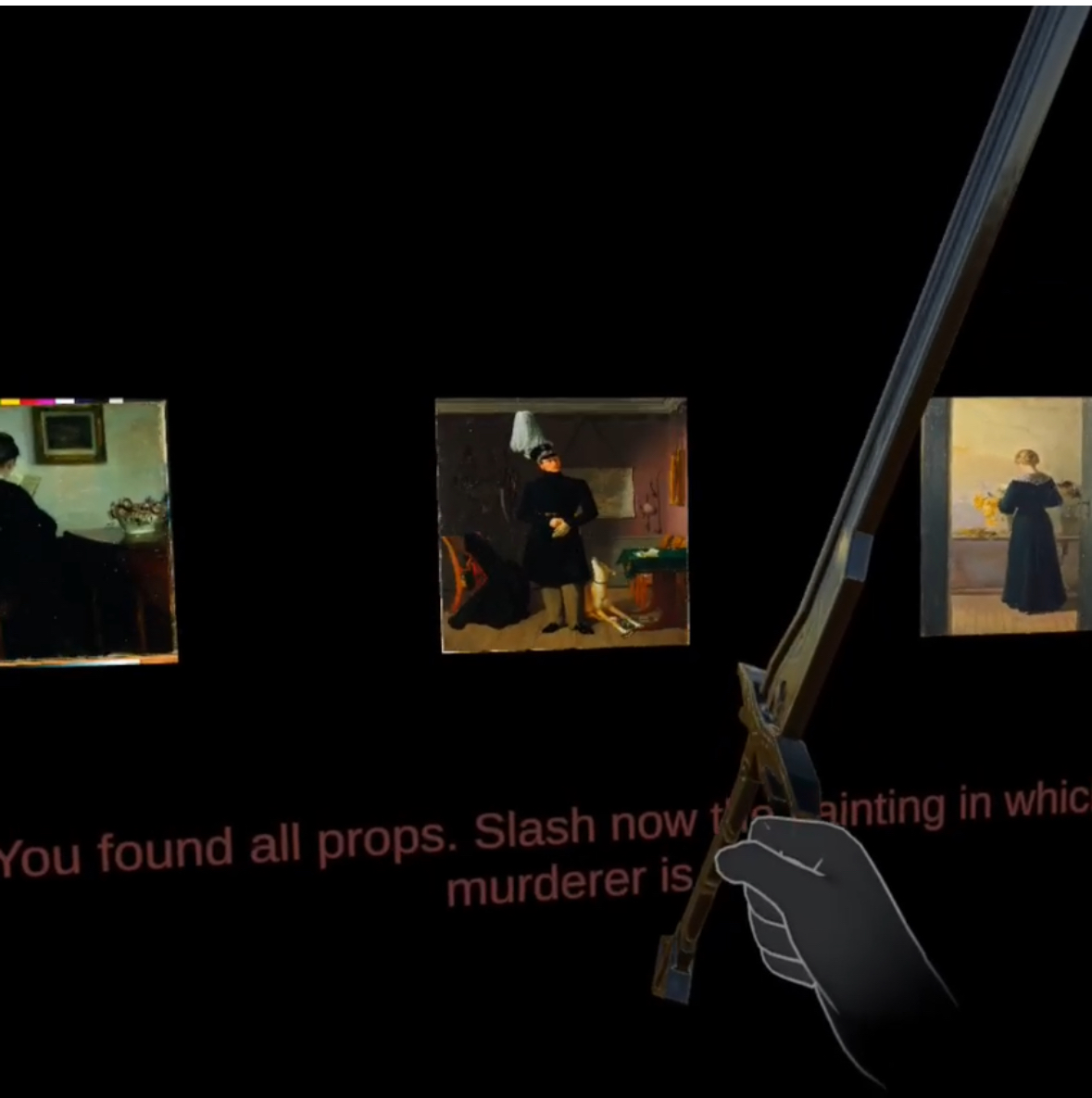
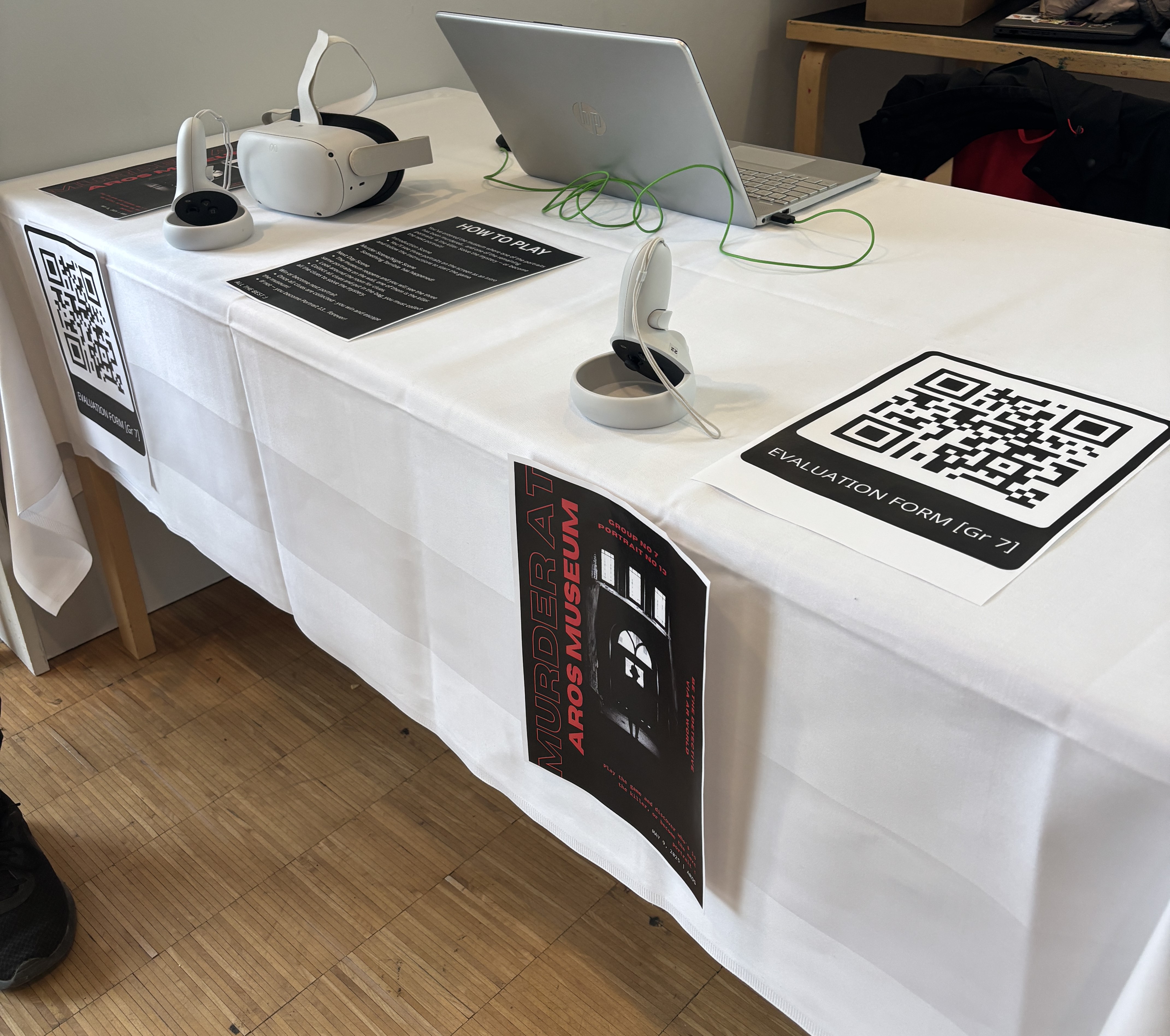
We showcased our Unity-built AR game, allowing players to:Interact with clues and paintings, examine virtual objects for clues, connect evidence etc
• Visual and Promotional Materials
We designed:
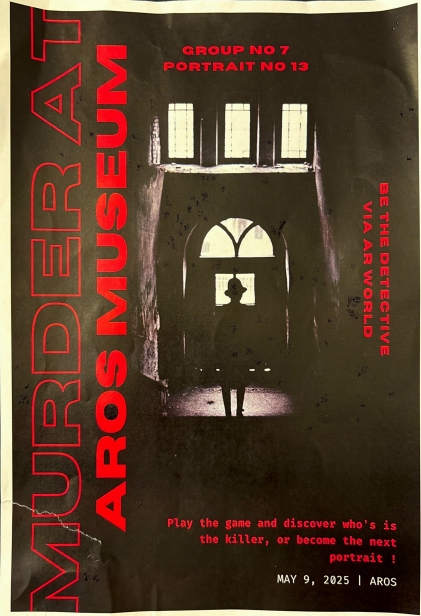
- A printed poster displaying the game’s core mechanics and aesthetics and how to play
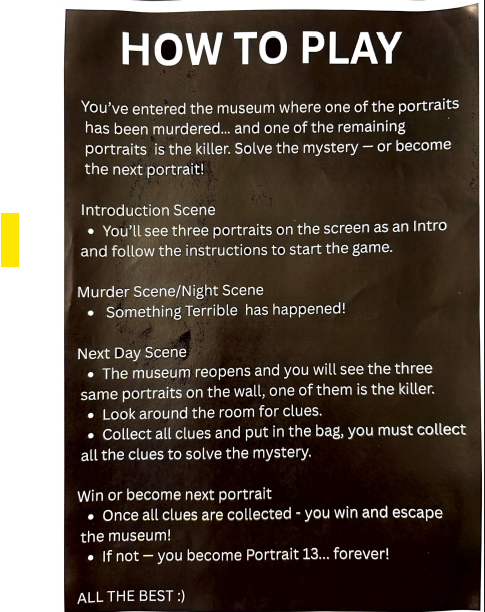
- detailed description for the visitors about our game and how to play
- A video presentation that outlined concept, game
- An interactive walkthrough of a sample scene as video
Narrative & Concept Pitch
Our team emphasized:
- How the murder has happened and how playing the game is connected to the values, and how the game makes those stories interactive
- How each game mechanic (clue-solving, portrait interaction) represents a facet of cultural preservation
- The integration of EU values: freedom of expression, human dignity, and cultural diversity
Technical Description
The game takes part in just one scene, so there is no switching between scenes involved. The scene consists of a canvas with three paintings attached to it. This is the heart of the scene and all the other game objects are oriented from this canvas. Further, The scene features multiple smaller props that are later used for the gameplay. Underneath the canvas is a text field attached which explains the functionality to the user.
The most important script is the Game Manager which saves the current stage of the game and also is used for switching between the phases of the game. Additionally to that, we implemented a Controller Manager which manages all the interactions that involve the controller. These interactions are phase specific ones like setting the location of the scene and also switching the Game state.
The smaller props that are located in the scene have their own script for each group of objects. These scripts manage that the object can only be seen at the right game stage and control the function of the respective game object.
Challenges
- Since our game has to feature a night scene, we were not sure how to implement this feature the best. Because a switch to a night scene would mean that the main scene would be reset after switching back to it. In the end we solved this problem by simply letting a very big black plane spawn 0.1 units away from the centerEyeAnchor. Since we also disabled the light source, this meant that the user's view was mostly completely dark, like we intended it to be.
- The placement of the scene was also a challenge for us. We used the Meta Quest 2, so there was no automatic calibration of the canvas to a wall possible. We solved this problem by using the controllers ring that is attached on top and layed the canvas “on” the controller if a button is pressed. Further we then made every other object a child of the canvas to keep the scenes layout after the position calibration. However, this brought the problem that the grabbable objects looked weird when grabbed. So we chose to not make these objects to children of the canvas but set them with a certain distance to the canvas.
Evaluation by Users
Purpose
Our primary goal was to assess:
• Whether the core concept was understood and engaging.
• If the cultural value of the game was recognized.
• How the game experience and AR interactions contributed to engagement and storytelling.
Evaluation Method
Feedback was collected through a Google Form completed by participants after playing the game at the EXPO. The form included a total of 8 questions:
• Six questions covering Concept and Theme, Game Experience and AR Interaction.
• Two open questions asking users what they appreciated most and what could be improved.
A total of 12 participants responded to the questionnaire.
Results
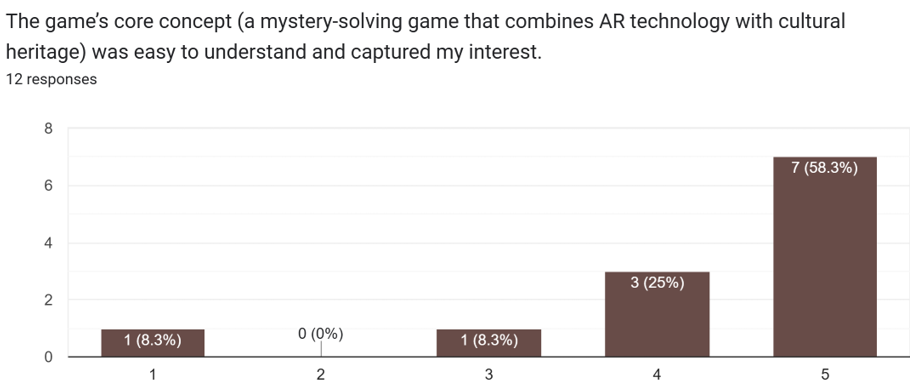
• Concept clarity and engagement: Over 80% of participants found the game’s core concept easy to understand and engaging (on a 5-point scale, seven users rated it a 5 and three gave it a 4).
•Cultural impact:
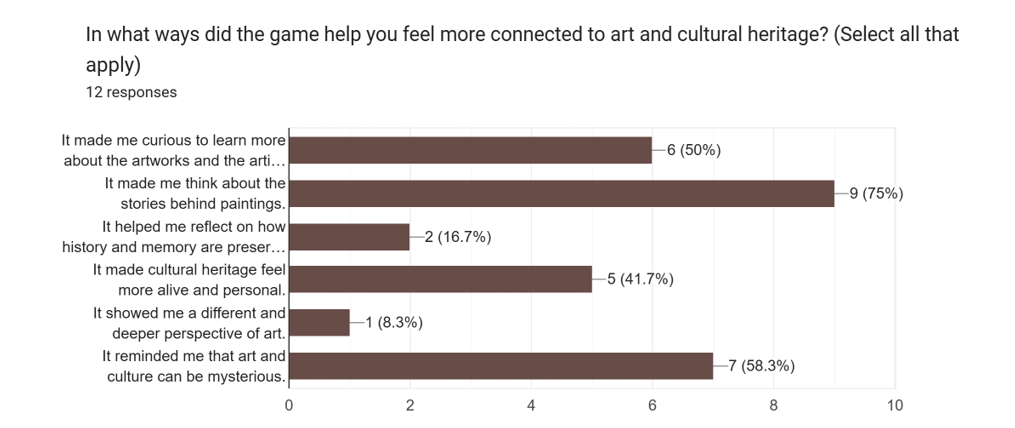
75% said the game made them reflect on the stories behind the paintings.
58.3% noted it reminded them that art and culture can be mysterious.
50% felt curious to learn more about the artworks and the artist
• Most impactful aspects:
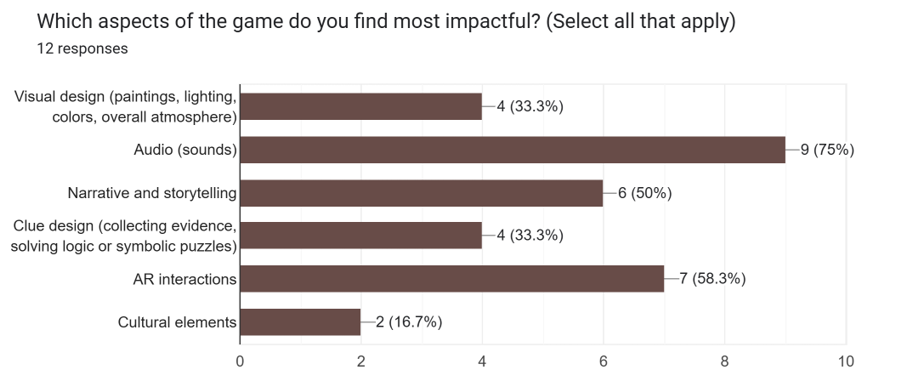
Audio was appreciated by 75% of participants.
AR interactions were impactful for 58.3%.
Storytelling resonated with 50% of the players.
• AR interaction:
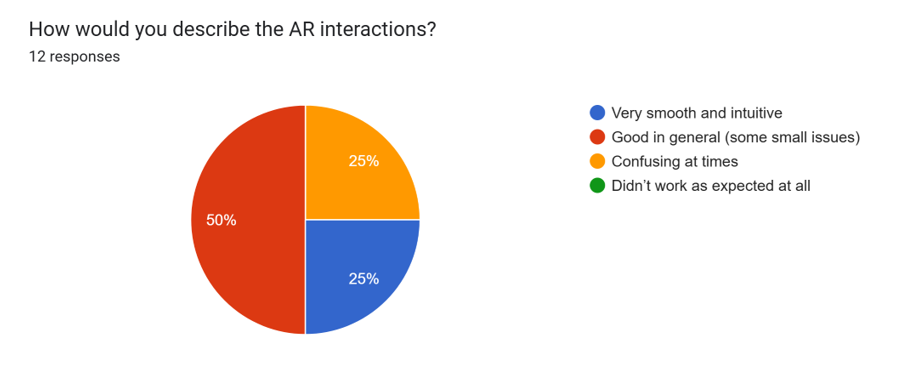
50% described the experience as “good in general” (with minor issues).
25% found it “very smooth and intuitive.”
25% experienced some confusion.
No users rated the interaction negatively.
• First Impressions and Evolving Experience:
Participants generally had a positive first impression, which stayed consistent throughout the gameplay. Some comments noted that with a few clarifications, the experience could be even more engaging:
“I had high expectations hearing the story and the concept, and I wasn’t disappointed. It was a nice experience.”
“The sound design was very cool. It would have been nice if there were more of that.”
“Very promising start! Mysterious.”
“At first I didn’t know what to expect, then I figured it out while playing.”
• Most Memorable Elements:
Players particularly enjoyed the audio design, clue collection and the final sword-based decision scene. The atmosphere and narrative were also commonly highlighted:
“Collecting the clues (it was very dynamic) and the sounds played during the night part.”
“The beginning in the dark and the end when slashing with the sword.”
“The last one that I collected the sword”
“The audio because you cannot see anything and just need to listen and focus”
• Suggestions for Improvement:
Users expressed interest in more complexity and clarity, especially in clue design and narrative depth:
“You can add more paintings and maybe have different levels to make it more complex.”
“The end needs more audio or texts.”
“Finding the clues felt a bit random. If it were based on the beginning, it would have been cooler :)”
Conclusions
• The core concept and audiovisual elements were highly appreciated.
• Cultural engagement was present but could be deepened.
• Users want more clarity in storytelling and better guided clue-finding.
• AR interactions were generally smooth, minor issues were reported.
Possible Improvements
• Refine clue design to feel more meaningful and structured.
• Enhance narrative clarity to reduce confusion.
• Emphasize immersive elements (sound, atmosphere) that users enjoyed most.
Leave a comment
Log in with itch.io to leave a comment.